Behavioral Signals Breakdown

Lenders evaluate behavioral signals by tracking how financial actions repeat across time.

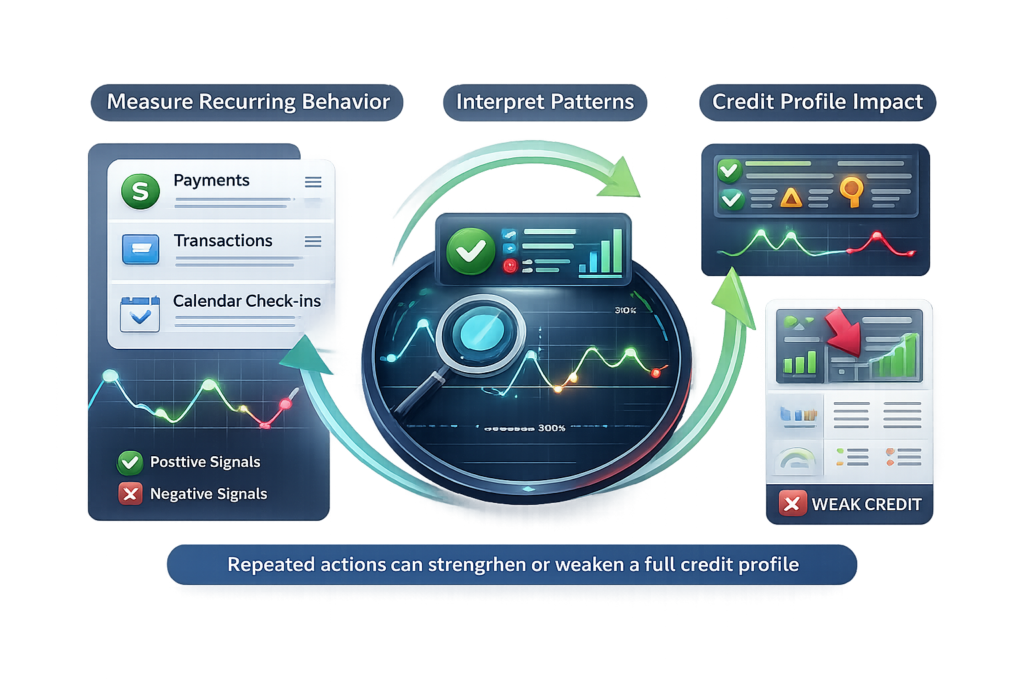
This breakdown explains how recurring behavior is measured, how patterns are interpreted, and why repeated actions can strengthen or weaken a full credit profile.

Recurring financial behavior measured, patterns analyzed, and impact on credit profile shown.

Core Behavioral Signals

These are some of the recurring behaviors lending systems use to interpret profile stability over time.

Payment Patterns
How consistently accounts are paid and whether behavior remains steady over time.
Reporting Cycle Alignment
How account reporting timing affects how recent behavior appears inside the file.
Balance Behavior
How balances rise, fall, and remain distributed across revolving accounts.
On-Time Consistency
How repeated on-time behavior contributes to confidence in future repayment stability.

How Lenders Track Behavioral Signals

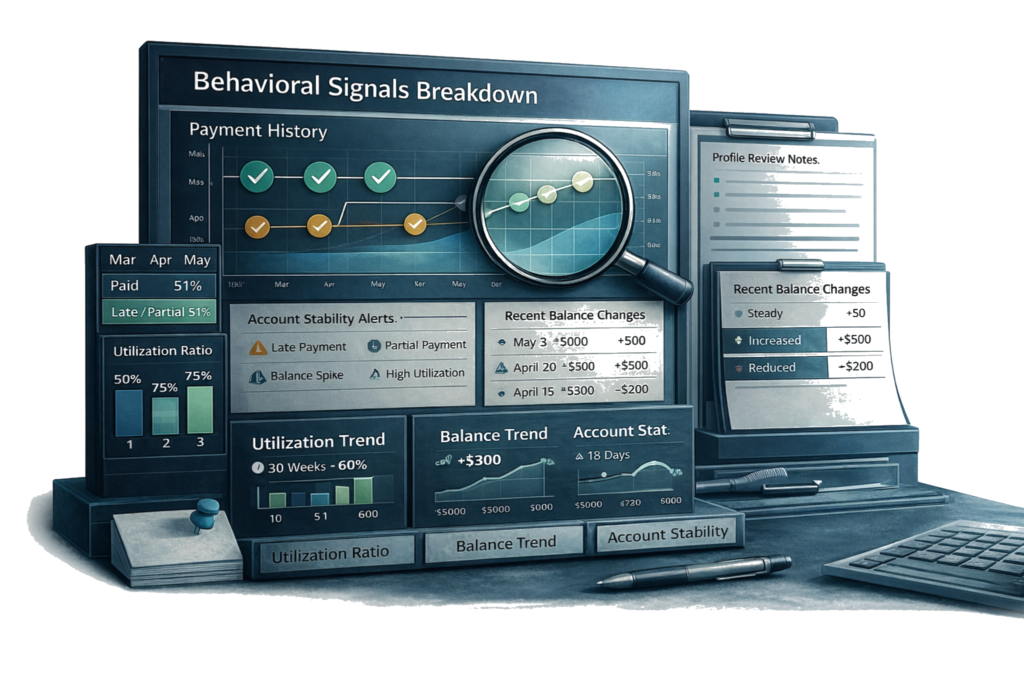
Behavioral signals are tracked by observing how actions repeat across reporting cycles, billing periods, and account activity over time.

Lenders are not looking for isolated moments.

They are looking for recurring behavior that creates a pattern stable enough to interpret.
Pattern Strength Inside Behavioral Signals

Not every repeated action carries the same weight. Lenders distinguish between strong patterns & weak pattern noise.

Strong Pattern
Behavior repeats across multiple cycles and appears stable enough to support lender confidence.
Weak Pattern
Behavior appears briefly, changes too often, or fails to create a stable signal across time.
Pattern Variation
Shifts in behavior are measured to determine whether change appears controlled or unstable.
Pattern Noise
Irregular behavior can create conflicting signals that reduce clarity in profile interpretation.

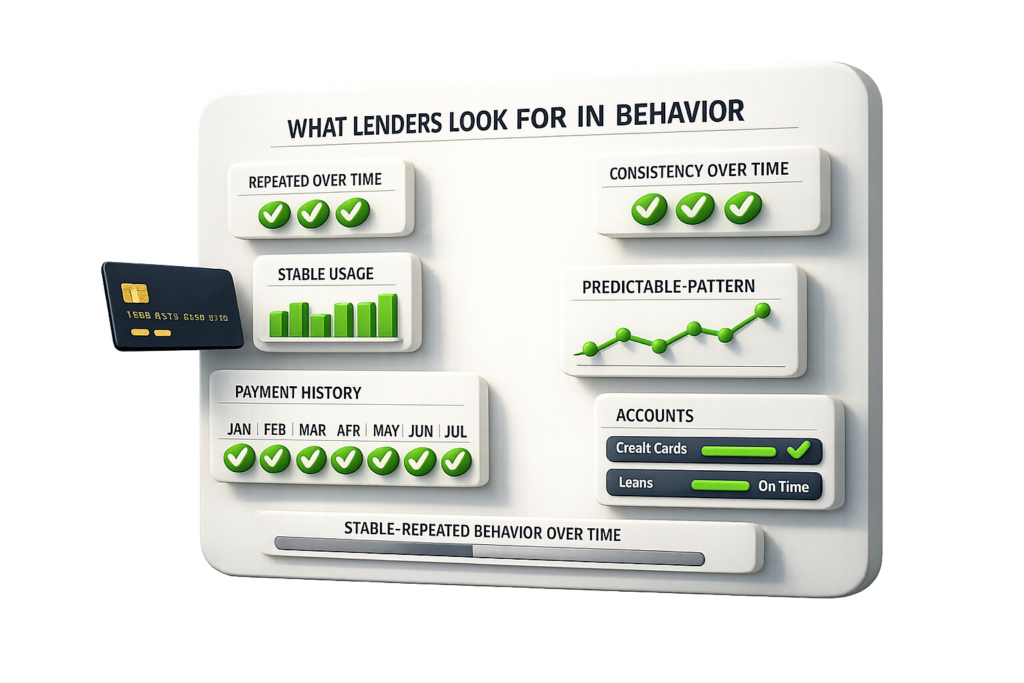
What Lenders Look For in Behavior

Behavior is not judged randomly.

Lenders look for whether actions repeat consistently, whether they change too often, whether they appear predictable, and whether they create confidence over time.

That means behavior is measured for pattern strength, not just activity alone.

Repeated financial actions such as payments and balances form patterns over time and are evaluated to understand a credit profile

How to Read This Layer

Start with repeated actions, not isolated events.

Look for consistency over time.

Then evaluate how those repeated behaviors influence the way the full profile is interpreted.

Behavior Does Not Work Alone

Behavioral signals are important, but they are not interpreted in isolation.
The same behavior can be read differently depending on account structure, balance distribution, profile age, and recent changes.
That is why behavior starts the pattern conversation, but does not finish it alone.

How Timing Changes Interpretation

Behavior is also judged by when it occurs.

A payment made before reporting can appear differently than one made after reporting.

A stable pattern over many months can be interpreted differently than a sudden change just before an application.

Timing shapes how behavior is seen inside the full profile.

What Weakens Behavioral Interpretation

Some behaviors reduce clarity because they weaken the pattern lenders rely on to interpret stability.

Inconsistency
Behavior changes too often and reduces confidence in future predictability.
Short-Term Improvement
Temporary changes may appear weaker than long-term pattern stability.
Reactive Movement
Sudden adjustments can make behavior appear pressured rather than controlled.
Conflicting Signals
Different actions occurring at the same time can weaken the overall behavioral picture.

Why This Breakdown Matters

Behavioral signals are often the first pattern layer that begins shaping lender confidence.

They influence whether a profile appears disciplined, reactive, unstable, or statistically uncertain.

That makes this layer one of the most important starting points in full credit evaluation.

Continue Into Structural Positioning
Move into the next layer to understand how account arrangement, profile depth, and age distribution influence lender interpretation.